Time Freed (Beyond Capture) Jin-me Yoon
A project produced by The Circle Project and co-presented by Gallery Gachet.
Opening Reception: October 31, 2026, 12-2PM
Location: Gallery Gachet, 9 W Hastings Street
Exhibition Dates: October 30 - November 7, 2026
For over forty years, artist Jin-me Yoon has engaged questions of representation, its limits, and the camera as a double-sided apparatus; historically implicated in categorizing, containing, and producing the Other, while also holding possibilities for intervention and self-representation. Yoon has often used her own body, natural and constructed landscapes, familial histories, and Korean diasporic experience as conduits through which to consider nationhood, gender, memory, and the complicated conditions of imposed visibility.
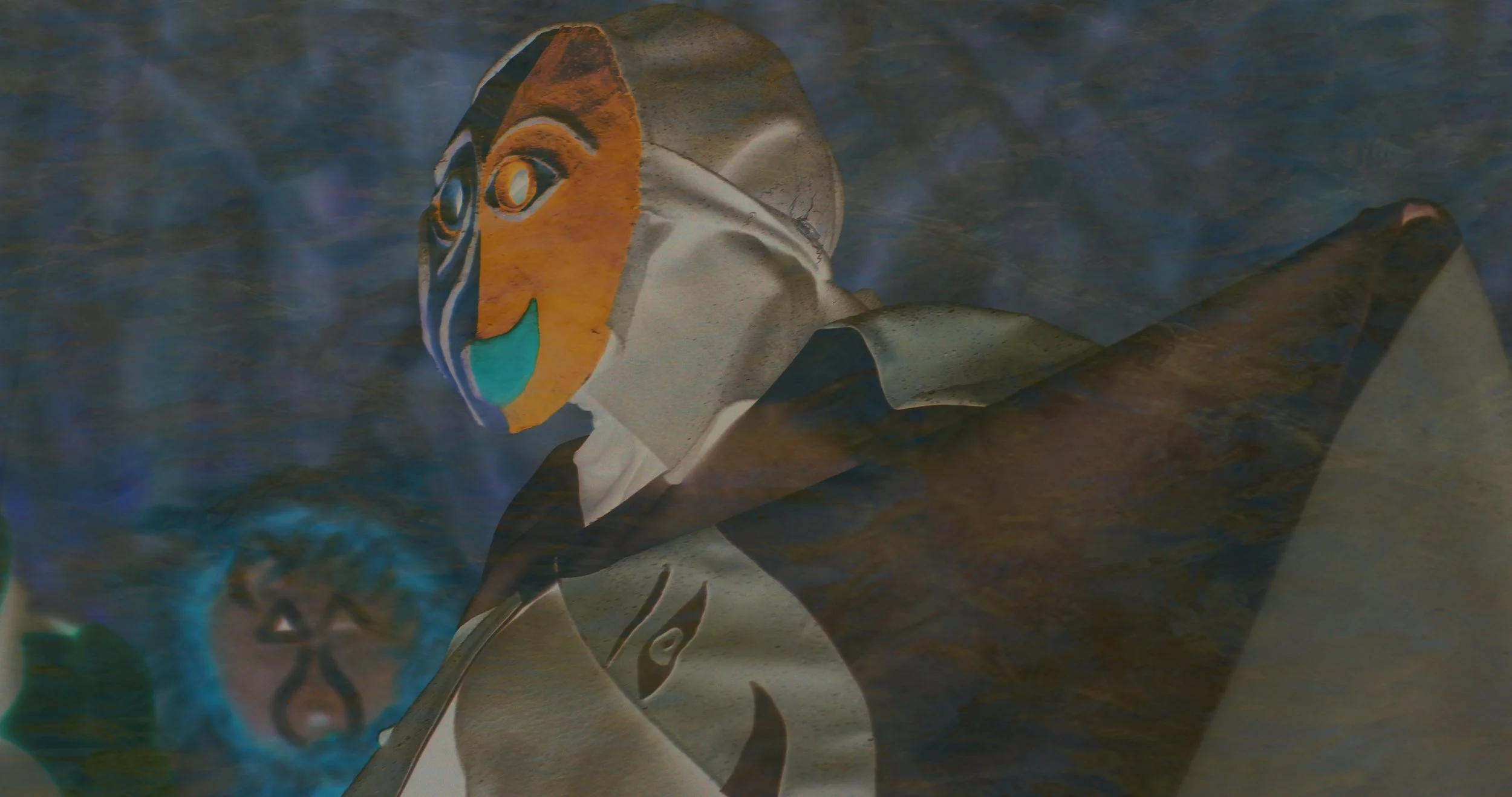
With Time Freed (Beyond Capture), produced by The Circle Project, Yoon extends these inquiries through an artistic exchange with fifteen women with lived experiences of incarceration. Bringing her formal and conceptual approaches into dialogue with the women's distinct perspectives and creative contributions, their encounters allow different forms of knowledge and artistic practice to inform one another. In doing so, Yoon considers the carceral nature of the image itself; how photography has historically participated in systems of surveillance, identification, racialization, and containment, and asks what it might mean for the represented body to move beyond capture.
Combining elements of Talchum, a Korean mask tradition rooted in performance, satire, and the reversal of dominant power, with contemporary costuming, choreography, somatic practice, and collective performance, Yoon develops a visual language through which the women move across the landscape, assuming different forms of presence. These acts of masking, movement, play, and transformation allow the women to enter the image without being made entirely available to it; to be visible without becoming entirely knowable.
The possibility of moving beyond capture, however, does not rest solely in the subjects' refusal to be made knowable, but also in the transformation of the image itself. Echoing Legacy Russell's formulation of the glitch as a rupture through which bodies might refuse imposed categories, Yoon disrupts the apparent stability of the photographic image. Colour reverses, bodies become spectral, landscapes shift, and the world is turned “inside out.” The camera no longer simply captures; its authority is unsettled.
Filmed at Whey-ah-Wichen (Cates Park), on the ancestral lands of the Tsleil-Waututh Nation, with the refinery looming across the water, Time Freed (Beyond Capture) connects carcerality to broader histories of colonialism, extraction, and dispossession. Yet the work ultimately looks toward possibility, toward time freed from surveillance, bodies freed from compulsory legibility, and futures beyond the systems that seek to contain them.
About Jin-me Yoon
Jin-me Yoon is a visual artist living and working on the unceded, ancestral, and traditional territories of the xʷməθkʷəy̓əm (Musqueam), Sḵwx̱wú7mesh (Squamish), and səlilwətaɬ (Tsleil-Waututh) Nations. Working across photography, moving image, performance, sculpture, sound, and installation, she has, for nearly four decades, situated her body, family, and communities within historically and politically charged landscapes, probing the permeable boundaries between the personal, the embodied, and the political.
Her work considers how nationhood, homeland, and belonging are constituted through the entanglement of human relations, historical memory, and ecological conditions. With particular attention to the interconnected histories of tourism, militarism, colonialism, and extractive expansionism, Yoon examines how images, sounds, and objects participate in constructing and regulating identities, while opening possibilities for imagining relations across human and more-than-human worlds.
A lifelong educator and learner, Yoon is a Professor at Simon Fraser University's School for the Contemporary Arts. Recent solo exhibitions include About Time at the Vancouver Art Gallery (2022–23) and her Scotiabank Photography Award exhibition at the Image Centre, Toronto (2023). She has also participated in group exhibitions at the Secession, Vienna (2024); the Hammer Museum, Los Angeles (2024–25); and the Bangkok Art and Culture Centre (2025). Her 80-metre photocollage Honouring a Long View spanned the façade of the National Gallery of Canada, Ottawa (2024–26).
Yoon was elected to the Royal Society of Canada (2018) and received the Scotiabank Photography Award (2022), the Governor General's Award in Visual and Media Arts (2025), and the inaugural Kim Byung-jong Art Award (2025). Recent publications include Jin-me Yoon (Steidl), About Time (Vancouver Art Gallery/Hirmer), and Jin-me Yoon: Life & Work (Art Canada Institute).
About The Circle Project
Founded in 2019 by Brenda Longfellow and Brenda Morrison, The Circle Project is an evolving collaboration between community and professional artists, including people with lived experiences of incarceration. Through collective storytelling, performance, moving-image practices, and collaborative art-making, the project seeks to challenge the violence and dehumanization of carceral systems while creating spaces for connection, experimentation, and self-determined expression.
Grounded in the belief that art can contribute to imagining worlds beyond incarceration, The Circle Project approaches creative practice as a means of building solidarity, community, and alternative social imaginaries.